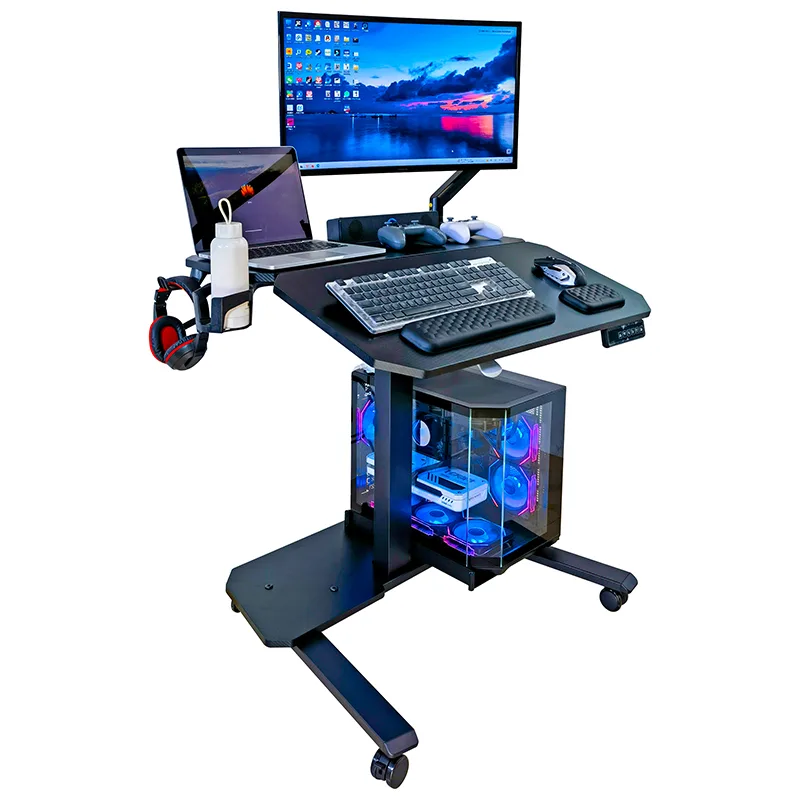
An esports room is not an office with better monitors. Schools, colleges and private esports venues buy desks for a room that changes function several times a day, is used by students whose height ranges from a 12-year-old to an 18-year-old, and gets cleaned, moved and bumped more in one term than a corporate desk does in five years. Buyers who source it like office furniture usually end up replacing it inside two years.
This guide is written from what we have learned manufacturing height-adjustable gaming desks and mobile desks in Shunde, Foshan, and from what education buyers, AV integrators and resellers ask before a first order. It is a specification guide, not a catalogue.
Six things separate an esports classroom from a corporate office fit-out:
Four buyer types, with different decision criteria:
One question sorts them immediately: are you the end user or a reseller? It determines whether you quote tax-inclusive installed pricing or ex-works dealer pricing.
| Specification | Typical esports room requirement | Why it decides the order |
|---|---|---|
| Desktop width | 1200–1600 mm for a dual-monitor station | An under-sized top is rejected on the first site visit |
| Desktop depth | 600–700 mm | Monitor arms and keyboard trays need the depth |
| Height range | Roughly 700–1200 mm on adjustable models; 720–760 mm fixed | Covers the student height spread and accessibility requirements |
| Load rating | 60–100 kg static | Dual monitors, a PC and a clamped monitor arm add up quickly |
| Frame stability | Lateral sway measured at full height | Wobble is the single most common complaint in shared rooms |
| Mobility | Lockable casters, 50 mm or larger | Lets the room change function without a furniture trolley |
| Cable management | Tray, grommet and a power-strip mount | A safety and inspection item in most school projects |
| Top finish | Scratch and moisture resistant, low emission | Daily cleaning with school-grade products |
Both, usually. The practical pattern we see in a 20–30 station room is a mix:
Electric lift is the easiest specification to justify in a tender document and the easiest for staff to operate. Gas-spring or manual lift sits in the middle on cost and avoids electrical compliance questions entirely, which matters for smaller projects. Decide this before you request pricing, because it changes the control box, the packaging weight and the documents the purchasing office will ask for.
Ask any supplier for the frame stability test and then repeat it on the sample:
Furniture for a room-sized project is bought by the container or the pallet, so packaging is a commercial question, not a logistics detail.
| Pack | Typical content | Notes |
|---|---|---|
| 1 carton = 1 desk | Frame, top, hardware, instructions | Flat-packed; a separate top carton often survives handling better |
| Pallet | Multiple desk cartons, strapped | Faster unloading at a school site |
| 20' container | First-order volumes for a single room or a small district | Ask for carton CBM, gross weight and stacking limit before you commit |
| 40' HQ | Full roll-out across several rooms or a district standard | Best landed cost per desk when the specification is frozen |
Ask for four numbers per model: carton CBM, gross weight, stacking layers and units per pallet. Without them, the freight quote is a guess. For a first project, LCL is normally cheaper than committing to a full container, and mixed loading of desks plus accessories usually improves the container fill.
This is the list that stalls orders at the last stage. Prepare it before the tender, not after:
A general answer such as "all certified" is not a document. Ask for the file and the standard number.
A first order of 20–40 stations is enough to fill a standard esports classroom or a computer room, and small enough to correct a specification mistake without writing off a year's budget. Order one sample unit plus a spare-parts pack first, assemble it with the people who will install the room, and run the checks in section 5 on it.
Nine questions that separate a supplier who can deliver a school project from one who cannot:
We manufacture height-adjustable gaming desks, mobile sit-stand desks and mobile desks in Shunde, Foshan, and supply bulk orders direct from the factory for esports rooms, schools and contract projects. If you are specifying a room and need dimensions, carton data or a bulk quote, send us the room plan and the station count. Our bulk orders page covers OEM and private-label programmes, and our best-selling adjustable gaming desk is listed here with full specifications. More sourcing guides are indexed on the blog.
We are the manufacturer — send us your specs and get a factory-direct answer within 24 hours.
Contact CHEUKHAM →