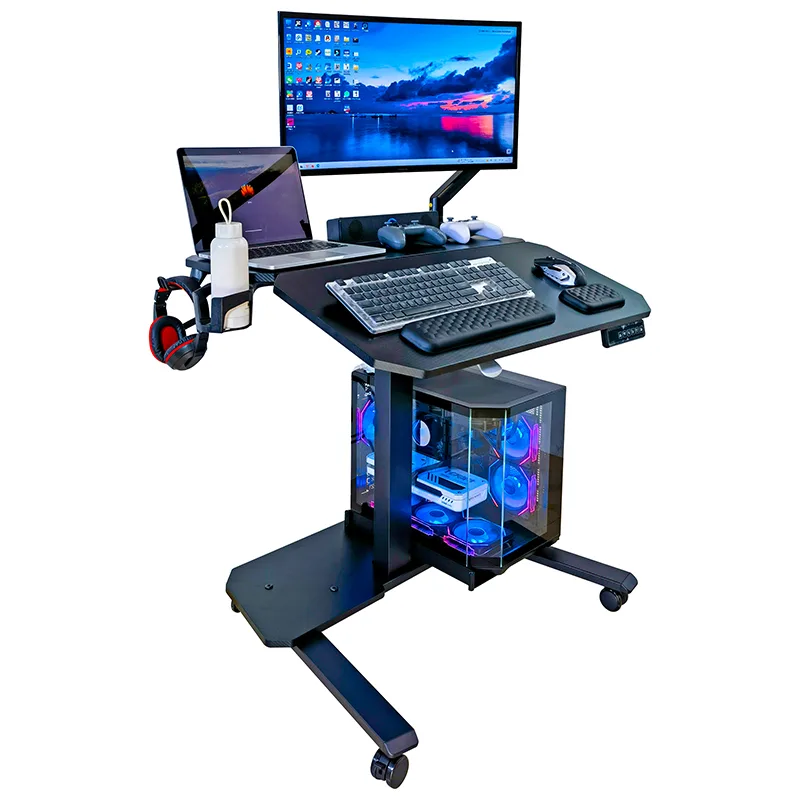
A startup buys furniture the way it buys everything else: under pressure, on a budget, and often without anyone who has done it before. The standing desk is the single most common request in that process — founders want the productivity and health angle, employees expect it as baseline office kit, and whoever is ordering it wants something that looks credible in a client video without breaking the spend plan. This guide walks through what actually matters when you are sourcing height-adjustable desks for a growing team: how to size the order, where to save money without buying junk, the specs that separate a desk that lasts from one that wobbles after six months, and the questions worth asking a supplier before you commit.
The standing-desk category has grown fast, which means more suppliers are chasing your budget — including some whose products look identical online but fail differently in practice. The difference is usually in the motor, the frame steel, and what happens after delivery. For a startup that cannot afford to replace 30 desks in year one, getting this right matters more than saving $12 per unit on a bad quote.
1. Why startups reach for standing desks (and why it is not just a trend)
The demand behind the purchase is real and durable, not office-fashion:
- Retention and perks — a sit-stand desk is one of the most recognised "good workplace" signals, cheap to provide relative to other benefits, and immediately felt by remote and hybrid staff who set up their own workspace.
- Health-and-safety pressure — in many jurisdictions the employer has a duty to assess workstation ergonomics. A height-adjustable desk directly addresses the seated-work risk that health-and-safety officers flag.
- Hybrid-equipment expectations — as teams return part-time, home-office kits are expected to match what is in the physical office. Buying two different-quality setups creates complaints fast.
- Video-first culture — a clean adjustable desk on camera reads as a serious operation. This is not superficial; founders routinely report that client perception tracks office setup.
The takeaway: the need is structural, so do not treat it as a discretionary splurge you can defer. But "structural need" does not mean "buy the most expensive option." It means buy the right spec for your volume and budget.
2. Single-motor versus dual-motor: what a startup actually needs
This is the single biggest spec decision, and it is where quotes diverge most:
- Single-motor desks — one actuator drives both legs via a linkage. Cheaper, lighter, lower weight capacity. Fine for a home-office setup or a desk that carries a monitor arm plus laptop only.
- Dual-motor desks — two independent actuators lift in sync. Higher load rating (often 100–150 kg), steadier under heavy multi-monitor setups, longer lifespan under daily use. The standard for a real office floor.
For a startup equipping a team of more than about five people with normal office loads (monitors, laptops, peripherals), dual-motor is the sensible default. Single-motor makes sense for founder home-office units or lightweight setups. Do not let a supplier quietly quote you single-motor when your cart says dual-motor — this is the most common point of confusion in first orders.
3. The specs that decide whether a desk survives year one
Online photos look identical across a wide price range. What differs, and what you should ask for:
- Frame steel thickness — commercial desks typically use 1.5–2.0 mm steel; cheaper desks drop toward 1.0 mm and visibly wobble under load. Ask for the millimetre figure, not "heavy-duty steel."
- Lift speed and symmetry — dual-motor desks should rise in sync within a couple of millimetres. Asymmetric lift is a sign of cheaper control logic.
- Preset positions — 3–4 memory heights are standard; worth confirming the handset stores them reliably, since that is what staff actually use daily.
- Cable management and power — an integrated tray or grommet plus a proper power strip matters more than buyers expect once ten desks are on a floor.
- Desktop material and edge — laminated board for budget, engineered or bamboo for a more finished look. Confirm the edge is rounded (safety) and the surface resists scuffs.
- Certifications that matter to you — electrical safety (UL/CE/FCC depending on market), and furniture-strength test reports. These are exactly the documents a factory can provide, so ask for them before paying.
4. Sizing the order: how many, and how to phase it
Do not buy every desk at once unless you have to. A phased approach protects cash and lets you validate quality:
- Phase 1 — pilot (5–8 units) — one per founding team member or a small sample across roles. Test for six to eight weeks before scaling.
- Phase 2 — core team — equip everyone who works on-site daily; leave remote staff with a home-office allowance instead of forcing an office desk.
- Phase 3 — growth buffer — keep one supplier line open so you can add units in two to four weeks as you hire, rather than stockpiling inventory.
This phasing is exactly what a flexible OEM factory supports: small first runs, then repeat orders at the same spec. It also means your Phase 1 pilot becomes the reference unit for every order after — keep one sample around to compare quality on later shipments.
5. Budget reality: what a correctly-sourced standing desk costs
Expect a realistic range rather than chasing the lowest number:
- Budget single-motor — adequate for light home use; watch steel thickness and warranty.
- Mid-range dual-motor (the sweet spot for startups) — credible build, memory presets, basic cable management. This is where most team rollouts land.
- Premium — higher load ratings, better finishes, longer warranties, custom surfaces or branding.
The trap is comparing the lowest quote against the highest spec. Compare like-for-like: same motor count, same steel thickness, same warranty. A desk that looks 20% cheaper but uses a single motor and thinner frame will cost more per year of use. Ask the supplier for a spec sheet side by side with each quote — if they cannot produce one, that is information in itself.
6. Questions worth asking a supplier before you commit
- What is the actual steel thickness of the frame, and can you show it?
- Do dual-motor models lift in sync, and what is the rated load capacity?
- What is your MOQ for a first order, and do repeat orders keep the same spec and price?
- Can you provide the safety certifications and strength test reports for the specific model?
- What does the warranty cover, and how long is it? (Warranty terms reveal a lot about build confidence.)
- How long is production, and can you ship a pilot batch faster than full volume?
- Do you offer custom surface sizes, logo printing, or packaging for a branded office?
7. Common mistakes startups make (and how to avoid them)
- Buying everything at once on faith. Pilot first; the test is cheap insurance against a bad batch.
- Chasing the lowest FOB price. Compare landed cost and per-year cost, not just unit price.
- Ignoring warranty and after-sales. A two-year warranty with a clear process beats a lifetime warranty you cannot enforce.
- Mixing specs across suppliers. Keep one reference model so later orders match the ones your team already likes.
- Skip the ergonomics angle. If health-and-safety compliance is on your radar, get the strength and electrical reports in writing from day one.
8. Next step
If you are equipping a startup or scaling a team, send us your target quantity, market, and any spec preferences (motor type, surface size, branding). We will come back with a tiered quotation that covers pilot quantities, repeat-order pricing, the certification pack for the models concerned, and a production schedule aligned to your hiring plan. Start small, validate, then scale — without changing the spec your team already trusts.
You can also request a bulk-order quotation or contact us directly with your specification.
Note: Steel thickness, load ratings, certifications and warranty terms vary by model and change over time. The figures in this guide are method and typical ranges, not quotations for a specific unit — confirm the actual spec in writing with your supplier before ordering.
Need a Quote or an OEM Partner?
We are the manufacturer — send us your specs and get a factory-direct answer within 24 hours.
Contact CHEUKHAM →