Choosing a standing desk manufacturer is rarely a matter of comparing price lists. Distributors, office furniture dealers, e-commerce sellers and contract projects all buy the same category for very different reasons, and the specification that suits a container load of flat-packed desks in Rotterdam will fail in a showroom in Dubai. This guide sets out the decisions that actually determine landed cost, failure rates and repeat orders, based on the way a real production line is organised.
Most factories in the category run three parallel product families: frame-only kits, complete desks with tops, and specialised variants such as gaming desks, converters and height-adjustable benches. Each family carries a different cost structure.
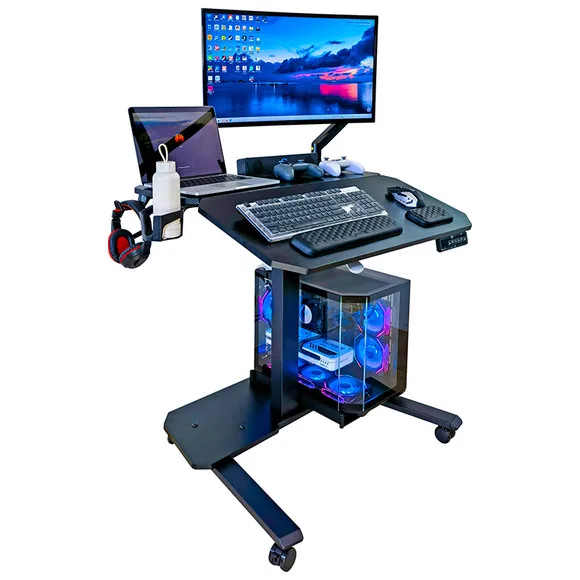
Frame-only kits travel in the smallest carton, so freight per unit is low and warehouse handling is simple, but the buyer must source tops locally and take responsibility for matching hole patterns, grommet positions and control-box mounting. Complete desks arrive ready to assemble and photograph well online, yet the top drives carton volume and freight. Specialised lines — for example a height-adjustable gaming desk with a PC tower holder — justify a premium because the accessory set is engineered into the frame rather than bolted on afterwards.
Ask any experienced buyer where standing desks fail in the field and the answer is consistent: motors, control boxes and handset cables. A dual-motor system with synchronised legs handles uneven loads better and is the correct default for commercial projects; single-motor designs remain viable for light residential use where the price ceiling is hard.
Confirm four things in writing before sampling: the duty cycle (typically 10 percent, meaning two minutes of movement followed by eighteen minutes at rest), the noise figure measured at one metre, the anti-collision sensitivity, and the memory preset behaviour after a power cut. A supplier who cannot state the duty cycle has not tested the product. Our own dual-motor electric standing desk is specified around these four parameters rather than around height range alone.
Height range sells desks; stability keeps them sold. Request a wobble test at maximum height with the rated load applied, not an empty-desk measurement. For a 1200 mm wide desk, a lateral deflection of a few millimetres at full extension is normal; visible sway at 500 mm of travel is a design defect in the leg profile or the foot.
Load ratings should be quoted per leg pair and tested to at least 1.5 times the stated figure. Beware of headline numbers such as "120 kg" that refer to a static test on a bench rather than a dynamic test on an assembled desk.
Certification requirements follow the destination, not the product. European buyers generally need CE marking with an EN 527 stability assessment for office furniture and RoHS compliance for electronics; North American buyers look for UL or ETL recognition on the control system and FCC for the wireless handset; contract projects increasingly ask for BIFMA X5.5 test reports. Ask for the certificate number and the testing laboratory, then verify it independently. A PDF with a logo is not a certificate.
Realistic MOQs for a mixed container are usually expressed per model rather than per order, and a manufacturer that quotes a very low MOQ on a custom colour is either absorbing tooling cost into the unit price or planning to substitute a stock finish. Lead time should be split into sample lead time, production lead time after deposit, and transit. Packaging deserves equal scrutiny: an ISTA-style drop test on the actual carton protects both the goods and your review score, and honeycomb corner protection is cheaper than a single damaged return.
Custom programs succeed when the brief is narrow. Bring a defined top size, edge profile, leg finish, handset type and carton artwork, and expect the factory to propose the frame. If you need a genuinely new mechanism — a folding converter, for instance — check whether the supplier already builds one, as with this foldable standing desk converter, because tooling a new hinge is a six-figure decision rather than a sampling exercise.
Before the purchase order: sample the exact SKU in the exact finish; test the duty cycle with a stopwatch; photograph the carton; confirm spare-part availability for motors, control boxes and handsets for at least three years; agree a defect rate and a replacement policy; and get the packing list dimension-checked against the container plan. These six items prevent most of the disputes that appear three months after delivery.
If you are sourcing for a distributor, a contract project or an e-commerce brand, send your specification, target market and annual volume and we will reply with a costed proposal, certification pack and sample plan. Email 23842190@qq.com or call +86 139 2918 1689 (WhatsApp available) and ask for the export desk team. You can also review the full range on our standing desk and gaming desk catalogue before the first call.
We are the manufacturer — send us your specs and get a factory-direct answer within 24 hours.
Contact CHEUKHAM →