Every first conversation between a standing desk factory and a new wholesale buyer comes down to two numbers: MOQ and lead time. Get them wrong and a promising catalogue addition turns into a cash-flow problem — dead stock on one side, empty shelves on the other. This guide explains what actually drives minimum order quantity on electric standing desks, how a realistic production timeline is built, and how professional buyers negotiate both without wrecking the price.
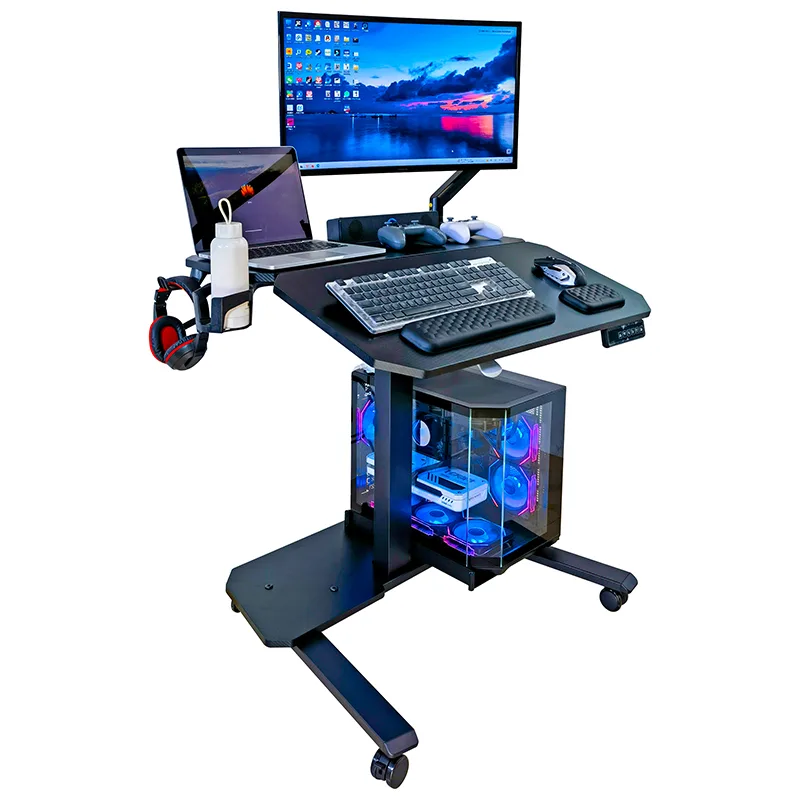
It is written from the factory side of the table, by a Shunde (Foshan, China) manufacturer that ships dual-motor sit-stand desks, pneumatic gaming desks and mobile adjustable desks to distributors, e-commerce sellers and office fit-out contractors (as of October 2026).
MOQ is not a number a factory invents to be difficult. It is the point where a production run stops losing money. Five variables move it:
Practical consequence: ask for MOQ per SKU and per finish, not one headline number. A supplier quoting "MOQ 50" who then cannot produce 50 units in your colour has not quoted you an MOQ at all.
The ranges below reflect how the sit-stand category is normally structured. Exact figures depend on model, finish and packaging — treat them as a framework for the conversation, not as a quotation.
| Order type | Typical scale | What it is for | Commercial notes |
|---|---|---|---|
| Sample / evaluation | 1–3 units | Testing stability, noise, assembly time, packaging quality | Paid at sample price plus freight; the real cost is the week you spend living with it, and it is the cheapest week you will ever spend |
| Trial order | Tens of units | First listing on a marketplace, a single showroom, a pilot project | Expect standard finish only; custom colour and printed cartons usually unlock at the next tier |
| LCL consolidation | Roughly a third to a full container of mixed SKUs | Multi-model catalogue without committing to a full container of one desk | Best balance for a new brand: several SKUs, one freight bill, one customs entry |
| FCL / programme order | Full container, repeating | Established distribution, contract furniture, private label | Where custom colour, branded packaging and scheduled monthly releases become economic |
"Lead time" is usually quoted as one number and then blamed when it slips. Break it into stages and the conversation becomes manageable:
| Stage | Typical duration | What can go wrong |
|---|---|---|
| Order confirmation and deposit | 1–3 days | Spec ambiguity — desktop size, colour code, handset version left open |
| Material preparation | 3–7 days | Steel coil or control-set shortage; custom colour paint not in stock |
| Production (cutting, welding, coating, assembly) | 10–20 days | Coating line queue; a change order mid-run resets the batch |
| Quality inspection | 1–3 days | Discovering a load or stability issue at this point is expensive for everyone |
| Packing and carton printing | 2–5 days | Printed cartons arriving late; retail inserts not approved in time |
| Inland haulage to port and booking | 2–5 days | Space on the vessel, not the factory, is the usual bottleneck in peak season |
Two honest rules of thumb: a repeat order of a standard model is dramatically faster than a first order of a custom one, and the vessel booking is often outside the factory's control. A supplier who promises a fixed date in peak season without mentioning booking risk is either inexperienced or telling you what you want to hear.
Buyers often compare quotations line by line and conclude the cheapest supplier is the best value. In this category the cost drivers are concrete, so ask about each one directly:
A useful discipline: ask every supplier to quote the same specification sheet. Comparisons only mean something when the column count, motor configuration, load rating and packaging are identical.
Before the container is sealed, a professional buyer confirms:
It depends on whether the model and finish are already in production. Standard models in standard colours support small trial batches; a new leg profile, custom colour or branded packaging raises the minimum because of tooling, coating-line and print-run setup. Always ask for MOQ per SKU and per finish.
Plan on roughly three to six weeks of production and inspection for a first order with any customisation, plus inland haulage and vessel booking. Repeat orders of standard models are considerably faster. Ask for a stage-by-stage schedule rather than a single date.
Yes — mixed-SKU consolidation is the normal way for a new brand to launch a catalogue without over-committing to one model. It requires planning packed dimensions per carton so the container is loaded efficiently.
Yes, and use it properly: test the brakes or feet on your actual floor, cycle the desk at full load, time the assembly, and check the carton condition on arrival. A sample is a fraction of the cost of a return wave.
Send an identical specification sheet — column stages, motor configuration, load rating, desktop material and thickness, handset functions, packaging — and ask each supplier to quote against it. Quotations built on different specifications are not comparable, whatever the totals say.
If you are evaluating suppliers for a 2027 catalogue, we are happy to send a specification sheet and a sample plan for our dual-motor sit-stand desks, pneumatic gaming desks and mobile adjustable desks. Contact our export team with your target market, volume and finish requirements, and we will answer with numbers rather than adjectives.
We are the manufacturer — send us your specs and get a factory-direct answer within 24 hours.
Contact CHEUKHAM →