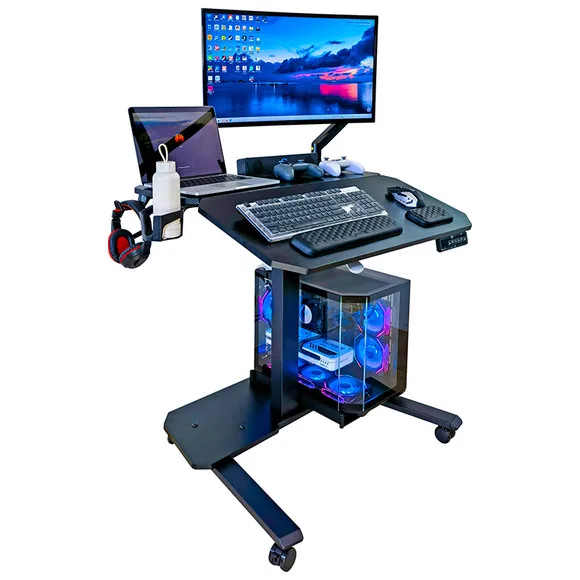
The October 2026 voluntary recall of 3M Precision Standing Desks (models SD60B and SD70B), announced in cooperation with the U.S. Consumer Product Safety Commission, is a useful reminder for anyone sourcing height-adjustable desks in volume: a standing desk is an electrical product with a lifting mechanism, a control box, and a load-bearing frame. When one of those subsystems fails, the consequence is not a cosmetic defect but a recall, a retailer chargeback, and a damaged brand. For importers, distributors, and private-label programs, the cheapest risk control is a documented supplier audit before the first purchase order, not a retrofit after the first incident.
Recall notices in this category cluster around four failure modes. First, control-box and handset electronics that overheat or fail to stop at the travel limit. Second, column and frame hardware that allows the desktop to drop or tilt under uneven load. Third, anti-collision sensitivity that is either disabled or tuned so loosely that the desk does not stop when it meets an obstruction. Fourth, documentation gaps: a product sold without a compliant label, a safety instruction sheet in the wrong language, or no traceable serial range.
None of these are exotic engineering problems. They are process problems, and they are visible in a supplier's documentation before you place an order.
Use the list below as a gate. A supplier that cannot answer items 1 to 5 in writing is not ready for a wholesale program, regardless of price.
| # | Check item | What acceptable evidence looks like |
|---|---|---|
| 1 | Electrical safety file | Test reports for the control box and actuator against the destination market's standard, with the report number and issuing lab named |
| 2 | Load and cycle testing | Dynamic load test at rated capacity plus a cycle count for the lifting column, recorded per production batch |
| 3 | Anti-collision behaviour | Written description of the sensitivity setting and a demonstration video at the factory's default setting |
| 4 | Travel limit and lockout | Confirmation that upper and lower limits are set in firmware, not only by the handset |
| 5 | Label and manual package | Artwork proofs for the rating label, warning label, and instruction manual in every shipping language |
| 6 | Traceability | Serial or batch coding that lets you map a finished desk back to a control-box lot |
| 7 | Change notification | A contractual commitment to notify you before a component or firmware change ships |
| 8 | Corrective action history | A plain statement of any recall, field failure, or customer claim in the past 24 months, and what changed as a result |
Most buyers send a price request and nothing else, then discover the compliance gap at the sample stage. Put the questions into the first message instead. Ask for the test report number for the control box, the rated dynamic load and the cycle count, the anti-collision default setting, and the exact wording of the warning label. Ask which components are sourced from third parties and whether the supplier will accept a change-notification clause. A supplier with a real quality system answers these in one reply. A trading company forwards them to a factory and answers in a week, or not at all.
Two more questions are worth adding for private-label programs: who owns the tooling and firmware configuration, and what happens to your label artwork if the relationship ends. Recall exposure follows the brand on the label, not the factory that built the desk.
The direct cost of a recall is the remediation: retrieval, replacement parts, labour, and disposal. The indirect cost is larger. Retail partners issue chargebacks and may delist the SKU. Marketplaces suspend the listing while they investigate. Insurance premiums move. And the buying team that approved the program spends the next quarter on incident management instead of on new business. For a wholesale program shipping containers, one recall can absorb several years of margin on the affected model.
Compliance is not a one-time document collection. Put it on a schedule: a full documentation review at onboarding, a factory audit before the second order, and an annual refresh of test reports and label artwork. Add a trigger review whenever the supplier changes a control box, an actuator, or a firmware version. That single habit catches most of the failure modes listed above before they reach a customer.
CHEUKHAM Furniture Co., Ltd is a manufacturer of height-adjustable standing desks, gaming desks, and mobile sit-stand desks based in Longjiang, Shunde, Foshan, Guangdong. We build for wholesale and private-label programs and we expect buyers to audit us. Our documentation package covers the electrical test file, dynamic load and cycle records, anti-collision default settings, label and manual artwork in the destination language, and batch coding for traceability. We also accept change-notification terms in the supply agreement, because a component change that surprises the buyer is a defect in our process, not in theirs.
If you are reviewing suppliers for a 2026 or 2027 program, send your checklist and we will answer it line by line, including the items where our answer is "this is what we do today and this is what we are changing." That is a more useful reply than a certificate pack with no report numbers.
Send your compliance checklist, target market, estimated annual volume, and required load rating to our contact page or email 23842190@qq.com. You can also review our standing desk and gaming desk range and the wholesale and bulk order program before you write. We reply to checklist requests within one business day, and we will tell you plainly which items we can evidence today and which need a factory visit.
This article is general sourcing guidance, not legal advice. Recall obligations and labelling requirements differ by market; confirm the applicable rules with your compliance counsel before shipping.
We are the manufacturer — send us your specs and get a factory-direct answer within 24 hours.
Contact CHEUKHAM →