Germany is Europe's most developed market for electric height-adjustable desks — and also its most demanding. Dealers, contract furnishers and office planners here do not buy on price alone: they buy on repeatable specifications, documentation, packaging quality and delivery reliability. This guide summarises what German and wider EU buyers typically specify, what paperwork to request from a supplier, and how to structure a first order that de-risks the relationship.
Why Germany Leads European Sit-Stand Demand
Three structural factors keep German demand ahead of the rest of Europe:
- Established ergonomic workplace culture. Height-adjustable desks moved from "nice to have" to standard fit-out in many corporate and public-sector projects years ago, so the category is well understood by end customers.
- A deep dealer and contract channel. Purchases usually flow through office furniture dealers, contract furnishers and systems integrators rather than direct-to-end-user, which means volume orders are normal and specifications are written down.
- Replacement demand. A large installed base from the last decade is now reaching end of life, creating steady refurbishment and replacement volume alongside new fit-outs.
For importers, the practical consequence is that German buyers rarely ask "what is your cheapest desk?" They ask "does this frame hold a 180×80 cm top at full height without wobble, and can you deliver the same specification in nine months?"
What German Dealers Actually Specify
When a German dealer writes a tender or an internal specification, the same parameters recur. Being able to answer these precisely — with numbers, not adjectives — is what wins the sample stage.
- Top size and thickness. 160×80 cm and 180×80 cm are the workhorses; 140×70 cm still appears in home-office and small-office lines. Tops are commonly 25 mm.
- Height range. Roughly 71–120 cm covers seated and standing use for the majority of users; wider ranges matter for accessibility-led projects.
- Drive configuration. Dual-motor frames are the default expectation for 160 cm and above; single-motor is acceptable for narrower, lighter configurations.
- Load capacity. Buyers look for headroom above the actual load — monitor arms, dual displays and docking stations add weight quickly.
- Stability at standing height. Wobble is the single most common complaint. Column design, foot depth and frame rigidity matter more than headline load figures.
- Noise and speed. Quieter operation is a real selling point in open-plan offices and shared rooms.
- Memory presets and controller. Multi-preset controllers are now expected, not optional, in the contract channel.
- Cable management and accessories. Cable trays, hooks and under-desk CPU holders are frequently specified as line items.
- Packaging. Flat-pack quality determines damage rates — and damage rates determine whether a dealer reorders.
Documentation: What to Request Before You Commit
Documentation is where serious buyers and opportunistic buyers diverge. Rather than accepting a supplier's summary claim, request the underlying items and verify each against your own checklist:
- Dimensional drawings for frame, columns and top fixing points
- Motor and controller specification (voltage, travel speed, duty cycle, standby consumption)
- Material and finish declarations for the frame, top and coating
- Packaging specification: carton dimensions, gross/net weight, units per pallet, container loading quantities
- Test and conformity documents applicable to your market, together with the issuing body and validity dates
- Spare parts availability and how a replacement controller or motor is ordered
A supplier who answers these in writing, with documents, is a supplier you can put in front of your own customers. A supplier who answers with a brochure is a risk you carry.
Import Practicalities for EU Buyers
German and EU importers generally handle these themselves, but they expect the supplier to support the process with accurate data:
- HS classification. Height-adjustable desks and desk frames fall under furniture headings; classification should be confirmed with your customs broker before the first shipment so duty and VAT treatment is known.
- Incoterms. FOB and CIF are the common starting points. Work out landed cost — freight, insurance, duty, import VAT, port charges, inland haulage — before comparing quotations.
- Wood packaging. Solid-wood crates and pallets need to meet ISPM 15 requirements; plywood and engineered board packaging is often simpler to handle.
- Container loading. Ask for units per 20' and 40'HQ early — it changes the economics of a first order far more than a small unit-price difference.
- Lead time and shipping schedule. Confirm production lead time separately from transit time, and agree how delays are communicated.
Structuring a Low-Risk First Order
The most common failure mode for a new supplier relationship is not quality — it is ordering too much, too fast, on an unverified specification. A more reliable sequence:
- Order a small trial quantity in the exact specification you intend to sell.
- Test fit, assemble, load and cycle the frame in your own workshop.
- Check packaging survival on the actual shipping route, not a short domestic hop.
- Show the sample to two or three of your own customers and collect objections.
- Only then place volume, with the specification frozen in writing.
This protects your margin and your reputation, and it gives the factory a clear target rather than a moving one.
Private Label and OEM
Many German and EU dealers sell under their own brand rather than the manufacturer's. Typical requirements are straightforward but must be planned:
- Branded cartons, labels and instruction sheets
- Controller and top branding
- Language-specific assembly instructions for each market you sell into
- Consistent article numbering across repeat orders
Confirm minimum quantities per branded article and how artwork revisions are handled, because packaging changes are the usual cause of delays in private-label projects.
A Supplier Vetting Checklist
Before adding any factory to your supplier list, get written answers to these:
- What is the exact frame specification, with drawings?
- What is the load capacity, and how was it measured?
- What is the height range and travel speed, and what is the noise level at full speed?
- What documentation can you provide for my market, and who issued it?
- How many units load into a 20' and a 40'HQ container?
- What is the production lead time for a first order and for repeat orders?
- How are damaged or defective units handled?
- Can you supply spare parts for at least the expected service life of the product?
- What changes between the sample and volume production, if anything?
Sourcing From a Factory That Supports Your Channel
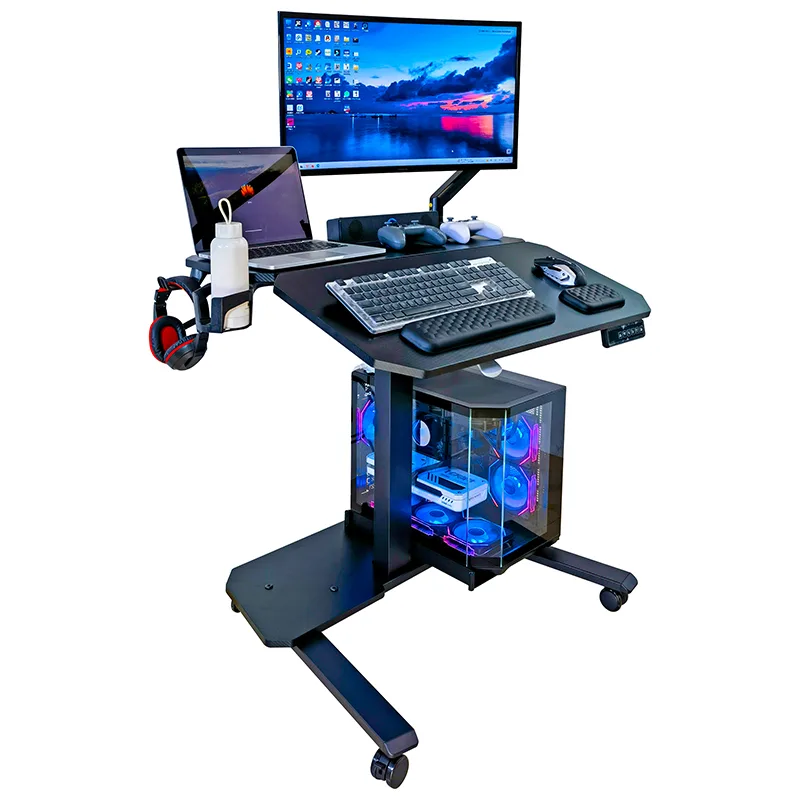
CHEUKHAM (Zhuhan Furniture Co., Ltd) manufactures electric height-adjustable desks, gaming desks and mobile laptop desks in Foshan, Guangdong — China's furniture manufacturing base. We work with dealers, importers and private-label brands that need specification-level answers, small trial orders and stable repeat supply.
If you are evaluating suppliers for the German or wider EU market, we can send our product catalogue with factory pricing, MOQ and lead times for a first order, dimensional drawings and packaging data for the models you are considering — so your team can check each item against your own requirements.
Next step: see our wholesale and bulk order terms, browse the full product range, or request a quote for electric standing desks with your target specification and quantity.
Need a Quote or an OEM Partner?
We are the manufacturer — send us your specs and get a factory-direct answer within 24 hours.
Contact CHEUKHAM →