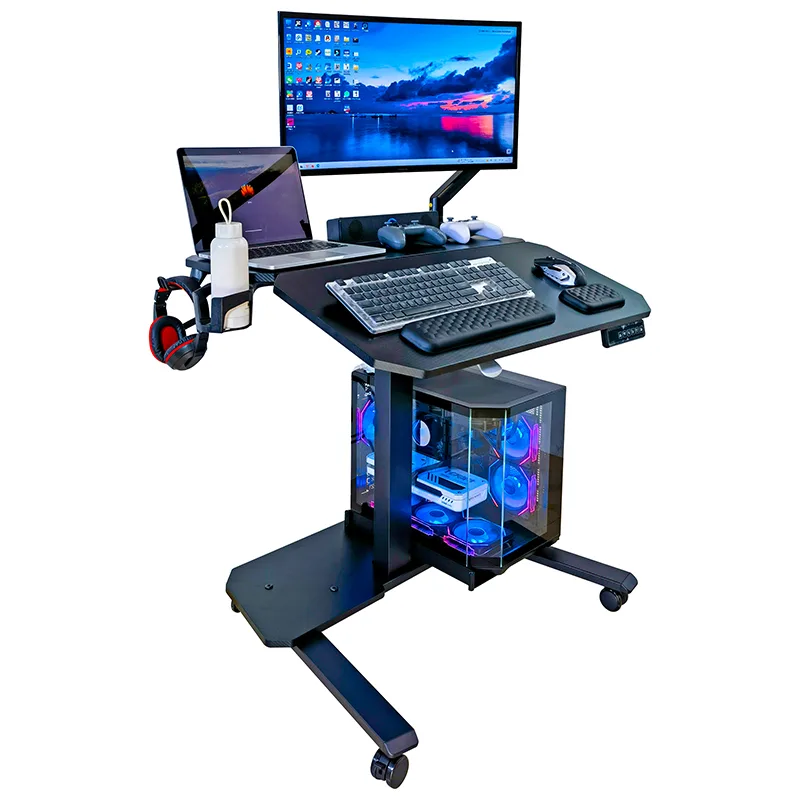
A gaming desk is not an office desk with lighting bolted on. It is bought by different people, for different reasons, and it fails in different ways. Esports venues, LAN centres, gaming retailers and education providers all specify it against criteria that rarely appear on a standing desk brief: monitor load, cable management capacity, surface durability under heavy peripherals, and whether the RGB and controller hardware survive a venue that is in use twelve hours a day.
That difference matters when you are sourcing. A supplier who treats a gaming desk as a cosmetic variant of a desk frame will quote you a price, and then fail on packaging, on finish consistency, or on the spare-parts support a venue needs in year two. This guide covers what we have learned manufacturing gaming desks and height-adjustable desks in Shunde, Foshan, and what dealers, retailers and venue operators ask before a first order.
1. Why gaming desks are a separate sourcing category
Three things separate the category from general office furniture:
- Load profile. A gaming setup concentrates weight in the middle of the surface — one or two large monitors on a mount, a heavy PC tower on or beside the desk, speakers, and a lot of peripheral hardware. A desk rated for a laptop and a lamp is not the same product.
- Surface and edge durability. Wrist pressure, mouse travel over a small area, and constant equipment movement wear a surface far faster than office use. Carbon-fibre-look laminates and textured tops are specified for feel and wear resistance, not only for looks.
- Accessory ecosystem. Cup holder, headset hook, controller rack, cable tray, monitor arm mounting points, and a tower shelf are frequently part of the SKU, not aftermarket add-ons. Buyers compare complete configurations.
2. Who actually buys gaming desks in bulk
Order profiles differ sharply by buyer type, and the specification should follow the buyer:
- Esports venues and LAN centres — repeatable, identical units, high durability, cable management that survives constant equipment changes, and spare parts.
- Gaming and electronics retailers — a mix of price-point SKUs, strong packaging (retail cartons that survive handling and can be displayed), and flat-pack efficiency for warehouse storage.
- Education and youth facilities — fixed-height units dominate, with rounded edges and stability requirements, often bought against a specification list rather than a catalogue.
- Corporate and studio buyers — gaming desks used for creative and streaming work, where height adjustment and cable management matter more than RGB.
- Distributors and wholesalers — they need carton efficiency, units-per-container data and finish consistency across the range more than any single feature.
3. Specifications that decide the order
The questions that come up in almost every serious enquiry:
- Surface size. 120x60 cm covers a single-monitor setup; 140x70 cm and 160x80 cm are the standard dual-monitor and dual-monitor-plus-tower sizes. Confirm the top thickness and the actual usable depth after any cable channel.
- Load rating. Ask for the distributed and the point load rating separately. A number without a definition is not a specification.
- Structure. Steel frame gauge, leg profile, and whether the frame is welded or flat-packed and assembled by the customer — this decides both stability and carton volume.
- Cable management. A routed channel or tray under the surface, grommet positions, and whether the tray is sized for a power brick and a controller charging setup, not just two cables.
- Tower and accessory fitment. Whether the PC shelf, cup holder and headset hook are factory-mounted or customer-fitted, and whether they can be omitted for buyers who do not want them.
- Lighting. Where the lighting is powered from (USB or a separate supply), whether it is a replaceable strip or integrated, and what happens when it fails. A venue buyer will ask.
- Finish consistency. If the same buyer stocks several sizes, the laminate and edge banding must match across the range. Mismatched finishes are a listing problem, not a cosmetic one.
4. Fixed-height or electric sit-stand gaming desks
Both sell, to different buyers. Fixed-height gaming desks win on price and on stability at the price point, and they dominate venue and retail orders. Electric sit-stand gaming desks — including mobile rolling models with a folding keyboard tray — win where the same desk has to serve gaming, streaming and work, and in venues where configurations change.
If you are ordering both, agree the finish family across the fixed and adjustable lines up front. A buyer who lists one will usually want the other to match.
Our distributor sourcing guide covers the adjustable side of that mix in more detail.
5. Packaging, carton efficiency and container loading
This is where gaming desk quotes diverge most, and where a cheap unit price can turn into an expensive landed unit:
- Ask for carton dimensions, gross weight and units per carton for each SKU, then price the freight yourself. Without carton data, a freight quote is guesswork.
- Retail packaging versus bulk packaging. Retailers need printable cartons that survive handling and display well; distributors often prefer the smallest possible carton. These are different specifications and should be quoted separately.
- Flat-pack versus assembled. Flat-pack reduces volume per unit substantially, which matters most on LCL shipments. Confirm the assembly time and the tooling included, because a customer-facing assembly problem becomes your after-sales problem.
- LCL for a first order, FCL once a mix has proven itself. Ask for the units-per-20ft and units-per-40ft HC figures for your actual mix before committing to a container.
- Incoterms in writing. FOB is the usual starting point for a first order; DDP only makes sense once the duty and clearance treatment is clear on both sides.
For the container arithmetic and Incoterms detail, see our import logistics and landed cost guide.
6. MOQ, trial orders and OEM branding
The most common first-order mistake is committing to a full range before testing demand. A workable structure:
- One LCL shipment or one pallet, not a container.
- Two or three SKUs — typically one fixed-height 120x60, one 140x70, and one height-adjustable model if you intend to carry both.
- Flexible MOQ on the first order, with repeat orders scaling afterwards.
- OEM/ODM terms agreed before production — your branding, your colours, your carton marking and your accessory configuration, so that a successful trial ships as your product rather than a generic one.
7. Documentation and quality checks
Any certification or test documentation your customers require should be confirmed in writing against your actual order, with the standard named and the issuing body named. A supplier who answers "yes, all certificates" without naming either is telling you nothing. The same applies to warranty terms, spare-part availability and how a replacement part is shipped — a venue with twelve identical desks needs to know how it repairs one.
Practical quality points worth agreeing up front: control and inspection at each production stage, pre-shipment inspection photographs or video, and a written packing list matched to the carton markings.
8. Nine questions to put to a factory before you commit
- What is the distributed load rating and the point load rating of this exact SKU?
- What are the carton dimensions, gross weight and units per carton?
- How many units fit in a 20ft and a 40ft HC container for my mix?
- Is the cable tray sized for a power brick and a controller charging setup?
- Are the tower shelf, cup holder and headset hook factory-mounted, and can they be omitted?
- How is the lighting powered, and is the strip replaceable by the customer?
- What are the OEM/ODM terms, and what is the minimum for a first order?
- What is the warranty, and how are spare parts supplied and shipped?
- Can you send pre-shipment inspection photos and a packing list before the goods leave?
We manufacture electric standing desks, mobile rolling sit-stand desks and gaming desks in Shunde, Foshan — China's furniture manufacturing hub — and supply dealers, retailers and venue operators as an OEM/ODM partner, with flexible MOQ for a first order. See our product range or the bulk order page, or send us your specification and we will come back with a quote for your market.
Need a Quote or an OEM Partner?
We are the manufacturer — send us your specs and get a factory-direct answer within 24 hours.
Contact CHEUKHAM →