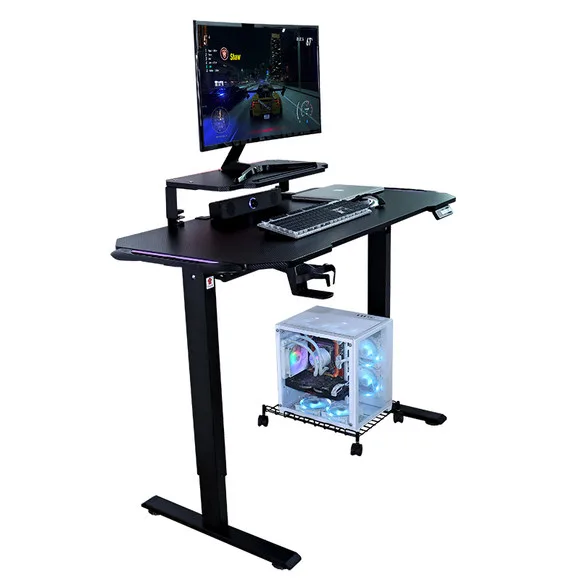
Most first-time importers lose money on the freight and duty side of a desk order, not on the unit price. A standing desk quoted at US$95 FOB can land at US$150–180 per unit once ocean freight, duty, import VAT, last-mile delivery and damage allowance are added — and that number, not the FOB number, decides whether the product works on your shelf. This guide covers the logistics layer of buying electric standing desks from China: how Incoterms shift risk, what packing data to collect before you book freight, how container loading actually maths out, how duty and documents are handled, and the timeline you should plan around.
For context on the size of the category: the global standing desk market was valued at roughly US$8.9 billion in 2025 and is projected to reach about US$18.6 billion by 2034, a CAGR of around 8.7% over 2026–2034 (Growth Market Reports, June 2026). Demand is durable — which is exactly why more buyers are entering the channel and why logistics competence is becoming a differentiator.
1. The landed cost stack: what you are actually paying per unit
Build your landed cost from the bottom up, in this order. Each line is a place where a poorly negotiated quote leaks margin:
- Ex-works / FOB unit price — the factory gate or the port of loading price. Everything else sits on top of this.
- Export packing — cartons, corner protection, palletising, edge boards. Sometimes quoted separately; ask.
- Inland haulage to port + terminal charges — usually inside an FOB price, but verify which port and which charges.
- Ocean freight — quoted per container or per CBM; volatile, and heavily season-dependent.
- Marine insurance — a fraction of a percent of CIF value; do not skip it on furniture.
- Import duty — set by HS classification and destination country (see section 5).
- Import VAT / sales tax — recoverable in many jurisdictions for registered businesses, but it is cash out of your account at clearance.
- Port charges, customs broker, delivery order — fixed per shipment, so they hurt small orders disproportionately.
- Last-mile delivery to warehouse — container drayage or LCL delivery; check whether tail-lift or residential delivery is needed.
- Damage and spare-parts allowance — budget 1–3% of goods value for transit damage and spares on furniture, then work to reduce it with better packing.
Two rules of thumb: fixed per-shipment costs mean one full container beats three LCL shipments on landed cost, and a supplier who gives you carton data early is a supplier who has actually shipped the product.
2. Incoterms in practice: EXW, FOB, CIF, DDP
Incoterms decide three things: who books freight, who carries risk at which point, and who clears customs. For desk imports the four you will see are:
- EXW (Ex Works) — you collect from the factory. Cheapest on paper, worst in practice for a first order: you are responsible for export clearance, inland haulage and loading, and the factory is not obliged to help. Avoid unless you have your own forwarder on the ground.
- FOB (Free On Board) — the standard for Chinese exports and the default we recommend for first orders. The supplier delivers to the named port and clears export; risk transfers when the goods are on board. You control the freight forwarder, which means you can see the real freight cost and use your own consolidation.
- CIF (Cost, Insurance, Freight) — the supplier books freight and insurance to your port. Convenient, but the freight number is a black box and is often marked up. Useful for a small trial order where you have no forwarder relationship yet; insist on the B/L and the insurance certificate being issued in your favour.
- DDP (Delivered Duty Paid) — the supplier handles everything including import duty. Tempting for small e-commerce restocks, but two warnings: the supplier may under-declare to make the number work (which is your customs liability, not theirs), and DDP pricing hides the true cost breakdown so you cannot benchmark it. If you use DDP, require a written declaration of the declared value and the duty paid.
Practical sequence for a new buyer: first order FOB with your own forwarder, then negotiate freight once you know your volumes. Never accept an Incoterm you have not read the definition of — risk transfer points are where claims are won and lost.
3. The packing data you must collect before booking freight
Freight quotes are only as good as the packing data behind them. Ask for this in writing, per model, before you request a rate:
- Carton dimensions in millimetres (L × W × H) — for every carton in the set. A standing desk is often two or three cartons: desktop, frame legs, control box/handset hardware.
- CBM per unit — cubic metres per complete desk, all cartons combined. This is the number that decides container loading.
- Net and gross weight per carton — gross weight decides whether you hit a container payload limit before you run out of space.
- Cartons per unit and whether they can be nested or palletised — palletised loads are faster to handle but consume volume; loose cartons load tighter.
- Stack height and stacking strength — furniture cartons get crushed at the bottom of a stack. Ask for the compression rating or, failing that, a floor-loaded versus pallet-loaded recommendation.
- Transit testing — a drop/compression test to a recognised transit standard (for example ISTA series) or at least a documented carton test report.
- Fragile-part protection — how the control box, handset, motor and actuator are packed; these are the parts that fail on arrival and they are small enough to be crushed between cartons.
If a supplier cannot provide carton data, treat the quote as provisional. CBM guessing is how buyers end up paying for air space they did not use — or discovering a container cannot hold the order they placed.
4. Container loading: how the maths actually works
Standard usable volumes, after practical loading losses, are roughly:
- 20' GP — about 28 CBM usable
- 40' GP — about 58 CBM usable
- 40' HQ — about 68 CBM usable
The loading calculation is simple division: units per container ≈ usable CBM ÷ CBM per unit. As a worked example (illustrative only — always plug in your supplier's actual carton data): if a complete dual-motor desk occupies 0.15 CBM packed, a 40' HQ holds roughly 68 ÷ 0.15 ≈ 450 units in theory. Apply a realistic loading loss — loose cartons with irregular shapes typically lose 10–15% against the theoretical figure — and plan on the order of 380–400 units. A bulkier 0.25 CBM unit drops the same container to roughly 230–270 units.
Then check weight before you celebrate the volume number. Container payload limits (commonly around 20–22 tonnes for a 20' and 26–28 tonnes for a 40' HQ, depending on the line and road limits at destination) are frequently the real constraint on metal-framed furniture. Take the gross weight per unit, multiply by the volume-loaded unit count, and confirm you are under the payload limit — not just under the CBM limit.
Three practical notes:
- Ask the factory for a loading plan with carton counts per row and stack. It is a five-minute job for them and it tells you whether the quote's unit count is credible.
- Mixed orders are normal. Desks plus desk risers, keyboard trays or castor sets can be co-loaded to fill the last few CBM — a good use of a container that would otherwise ship at 85% utilisation.
- Do not confuse a supplier's "container quantity" claim with your own maths. Recalculate it from carton dimensions; discrepancies of 15% are common and they change your landed cost per unit.
5. HS classification and duty: the number that decides your price
Height-adjustable desks are generally classified in HS heading 9403 — other furniture, with the subheading depending on the predominant material:
- 9403.10 — metal furniture of a kind used in offices (typical for a steel-framed desk where metal predominates).
- 9403.30 — wooden furniture of a kind used in offices (typical where the desktop and structure are predominantly wood-based panels).
- Accessories and parts — desk risers, keyboard trays and loose frame components may fall under different subheadings or be treated as parts of furniture. Do not assume they follow the desk.
Three things to be clear about before you commit to a retail price:
- Classification is decided by your customs broker, not by the supplier. Ask your broker to classify the actual product — predominant material, function, and whether the motorised lifting system changes the analysis. Get the ruling in writing before the goods sail, not after they arrive.
- Additional tariffs may apply to goods of Chinese origin in some markets, on top of the standard MFN rate. These change with policy and are country-specific, so confirm the current rate and any exclusions with your broker rather than relying on an old quote. Where a trade agreement applies, a certificate of origin can change the duty rate — check eligibility before shipping.
- Import VAT or sales tax is a cash-flow item, not a cost if you are VAT/GST-registered and can recover it. Model it in your cash flow anyway; it is paid at clearance.
On the supplier side, what we can provide is the input your broker needs: exact product composition, material breakdown, motor and control box specifications, and the commercial invoice structured to match the declared classification.
6. The document pack that must travel with the goods
Missing documents are the most common reason a container sits at port accruing storage. Confirm each of these exists before the vessel sails:
- Commercial invoice — buyer, seller, description matching the classification, unit price, Incoterm, currency, and the declared value you actually intend to declare.
- Packing list — carton-by-carton: model, quantity, dimensions, net and gross weight. This is also your tool for counting in a damage claim.
- Bill of lading — original or telex release; make sure the consignee and notify party are exactly right, and that freight terms match your Incoterm.
- Certificate of origin — general CO, or a preferential form if a trade agreement applies to your market.
- Insurance certificate — issued in the buyer's favour when the seller arranges insurance.
- Compliance documents — CE documentation for the EU, UKCA support for the UK, FCC/EMC documentation for the US, plus RoHS and furniture strength reports for the models in the shipment.
- Any destination-specific clearance paperwork — for example packaging responsibility registrations where the market requires them.
Ask for scans of the full set at least a week before sailing. Fixing an invoice description at the factory takes minutes; fixing it after the container is on the water takes weeks.
7. Timeline: what to plan for and when to book
Plan the calendar backwards from the date you want stock in your warehouse:
- Samples — allow time for a sample unit and a full inspection of the motor, control box and finish before committing to a production order.
- Production — repeat orders commonly run about 25–35 days of production. A first order with custom surfaces, printed packaging or logo work runs longer; plan 45–60 days door to door.
- Booking — book space two to three weeks ahead in peak season. August to October is the heaviest export window out of South China, and rates and space both tighten.
- Chinese holiday shutdowns — the National Day Golden Week in early October and Chinese New Year both compress the factory calendar for roughly a week or more, with slower output on either side. Any order placed near those windows needs buffer.
- Ocean transit — varies enormously by route and service; get the figure from your forwarder for the specific port pair rather than assuming a regional average.
- Clearance and delivery — add a few days for customs, and note that pre-holiday congestion at destination ports can add more.
Two operational habits that pay: get a written production schedule with the deposit confirmation, and ask for a photo update at packing. The packing stage is your last chance to catch a wrong carton count before the container is sealed.
8. Damage control: the part of the cost you can actually reduce
Furniture arrives damaged because of packing, handling and stacking — in that order. What to agree with the supplier:
- Corner protection and edge boards on desktops, and separation between stacked cartons.
- Double-wall cartons for e-commerce channels, where the carton is handled repeatedly and sometimes shipped onward to the end customer.
- Protected control box, handset and motor — the small, expensive parts that fail when cartons are stacked on them.
- A pre-shipment inspection — third-party (for example SGS or BV) or your own representative. For a first order it is cheap insurance; ask for a written inspection report with photographs and a sample of cartons opened and checked.
- A stated spare-parts allowance — for example a percentage of units supplied with spare control boxes or handsets, agreed in writing before production.
- A claims procedure with a deadline — what happens, to whom, with what evidence (photos, packing list, survey report) and by when. Agree it in the purchase order, not after the damage.
9. Your landed cost worksheet
Fill this in for every quotation you receive and compare suppliers on the total, not the FOB price:
- FOB unit price (per model, at the quoted MOQ)
- Cartons per unit · CBM per unit · gross weight per unit
- Units per 20' GP / 40' GP / 40' HQ (your calculation, not the supplier's claim)
- Ocean freight per container ÷ units = freight per unit
- Marine insurance per unit
- Duty rate (from your broker's classification) × declared value
- Import VAT / sales tax (and whether it is recoverable)
- Port, broker and delivery charges ÷ units
- Damage and spares allowance
- Total landed cost per unit → compare against your target sell price and channel margin
Buyers who do this consistently find the same thing: the supplier with the lowest FOB price is often not the supplier with the lowest landed cost, because better packing, tighter carton dimensions and accurate carton data are worth more than a few dollars off the unit price.
10. Next step
If you are planning a first or repeat container of height-adjustable desks, send us your target market, destination port and rough annual volume. We will come back with an itemised quotation that includes carton dimensions and CBM per unit, MOQ tiers, the certification pack for the models concerned, and a written production and shipping schedule — the four inputs you need to complete the worksheet above.
Related guides from our blog: Electric Gaming Desk Wholesale 2026, Standing Desk Certifications for Importers, How to Choose an Electric Desk OEM Manufacturer, How to Find a Reliable China Furniture Exporter for Desks and Wholesale Standing Desk Manufacturer: How to Buy Direct.
You can also request a bulk-order quotation or contact us directly with your specification.
Note: HS codes, duty rates, tariff measures and container payload limits vary by product, route and destination, and change over time. The classification and duty figures that apply to your shipment must be confirmed with your own customs broker. Container figures in this guide are worked examples for method, not quotations for any specific model — always calculate from the actual carton data supplied with your quotation.