North America is not one market with one specification. A US buyer ordering for a corporate contract account and a Canadian dealer stocking a web store share the same product category, but they ask different questions about electrical compliance, panel emissions, carton marking and duty treatment. Getting those answers wrong does not lose you a discount — it loses you the order at the sample stage.
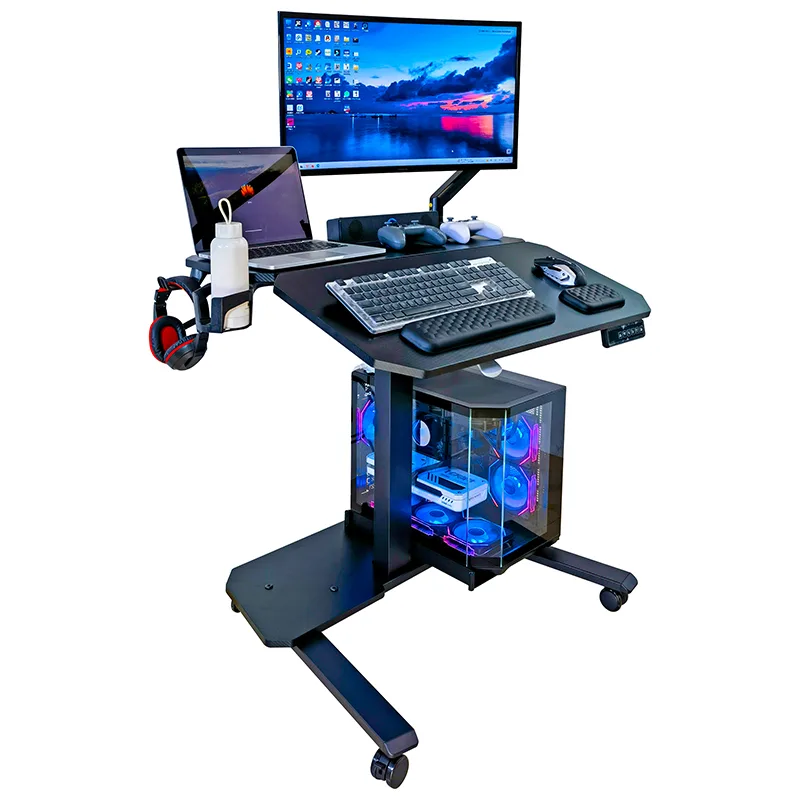
This guide covers what we have learned manufacturing electric standing desks, mobile sit-stand desks and gaming desks in Shunde, Foshan, and what US and Canadian dealers, distributors and contract buyers ask before a first order.
1. Why North America is a separate sourcing specification
Five things separate a North American specification from a European or Asian one:
- Electrical. 120V / 60Hz with a NEMA 5-15P plug is the default for the US and Canada. A 230V control box built for the EU market cannot simply be re-plugged, and a control box without North American listing is a specification problem for the buyer, not a documentation detail.
- Listing and test documents. US buyers ask for a listed control box and, for contract and education work, a load test report against a named standard. Ask for the standard number and the issuing body — a general "all certified" answer is not a document.
- Panel emissions. Composite and MDF tops sold into the US are expected to meet the formaldehyde emission limits under TSCA Title VI (with CARB as the California reference point). This is a materials question, and it is asked early.
- State-level labelling. California's Proposition 65 warning requirement affects how a product and its packaging are labelled for the US market. Confirm with your buyer which warning text their channel requires.
- Bilingual Canada. Canadian retail and contract channels frequently require English and French on packaging and instructions. This is a packaging specification, and it is cheaper to agree it before production than to sticker cartons after arrival.
2. Who buys standing desks in bulk in North America
Order profiles differ sharply by buyer type, and the specification should follow the buyer:
- Online specialists and independent e-commerce dealers — a tight range of price-point SKUs, strong retail cartons, fast replenishment, and finish consistency across sizes so the range lists as one family.
- Regional office furniture dealers and wholesalers — carton efficiency, units-per-container data and repeatable quality matter more than any single feature. They often buy both fixed-height and adjustable lines.
- Contract furniture dealers and corporate projects — specified against a brief, frequently with a colour and finish schedule, and with a documented warranty and spare-parts route.
- Education (K-12 and university) and public sector — bought against a specification list rather than a catalogue, with stability, edge safety and a documented maintenance path for a large identical fleet.
- Multi-site corporate buyers — the same desk repeated across offices; consistency of finish and of spare parts is the deciding factor.
3. The electrical and control specification, in the numbers buyers actually ask for
Most serious North American enquiries come down to the same table. Fill it in per SKU rather than per range:
| Specification | What the buyer needs |
|---|
| Input | 120V / 60Hz, NEMA 5-15P plug (US and Canada) |
| Motor configuration | Single or dual motor, and the resulting speed and noise figures |
| Height range | Lowest and highest height in both inches and centimetres, plus the frame-only range before the top is fitted |
| Load rating | Distributed and point load stated separately — a number without a definition is not a specification |
| Top size | Both imperial and metric (48x24 in / 120x60 cm, 60x30 in / 150x75 cm are the common US sizes) |
| Control features | Memory presets, anti-collision, lock, and whether the controller is replaceable in the field |
| Cable management | Tray or channel, grommet positions, and whether it fits a power brick rather than only two cables |
If the same buyer stocks fixed-height and adjustable lines, agree the finish family across both up front. A dealer who lists one will usually want the other to match, and mismatched laminate or edge banding is a listing problem rather than a cosmetic one.
4. Documentation US and Canadian buyers ask for
Any certification or test document your customer requires should be confirmed in writing against your actual order, with the standard named and the issuing body named. A supplier who answers "yes, all certificates" without naming either is telling you nothing. The documents that come up most often in North American enquiries:
- Listed control box documentation for the electrical assembly supplied with the desk.
- Load and stability test reports against the named standard your contract or education customer specifies.
- TSCA Title VI / CARB panel documentation for the tops and any composite parts.
- Proposition 65 labelling text where the US channel requires it.
- Packing list matched to carton markings, plus pre-shipment inspection photographs or video.
- Warranty terms and spare-part availability, including how a single replacement part is shipped to a site with twelve identical desks.
5. Packaging, pallets and container loading
This is where North American quotes diverge most, and where a cheap unit price becomes an expensive landed unit:
- Pallet dimensions matter. 48x40 in is the standard North American pallet footprint (GMA). If cartons are designed for a European 1200x800 mm pallet, palletisation and warehouse handling change. Ask for carton dimensions, gross weight and units per carton per SKU.
- Retail cartons versus bulk cartons. E-commerce dealers need printable cartons that survive handling and display well; wholesalers often want the smallest possible carton. These are different specifications and should be quoted separately.
- Flat-pack versus assembled. Flat-pack cuts volume per unit substantially, which matters most on LCL. Confirm assembly time and tooling included, because a customer-facing assembly problem becomes your after-sales problem.
- Port choice changes the maths. West coast (Los Angeles / Long Beach) versus east coast or Gulf entry produces different inland costs and transit times for the same FOB price. Ask for units per 40ft HC and per 20ft for your actual mix before committing.
- ISF 10+2. US importers must file an Importer Security Filing before loading. Your buyer files it, but they need your supplier and container data early enough to do so.
For the container arithmetic and Incoterms detail, see our import logistics and landed cost guide.
6. Duty, HTS classification and terms
Desks and desk frames typically fall under HTS heading 9403.10, but the exact subheading, and any additional duty treatment that applies to goods of Chinese origin, is a moving target: rates and product lists change by administrative action. Confirm the current classification and any additional duty with your customs broker against the actual product before you build a landed-cost model — do not price a North American programme on last year's duty rate.
FOB is the usual starting point for a first order. DDP only makes sense once the duty and clearance treatment is clear on both sides, and once the importer of record has been agreed in writing.
7. MOQ, trial orders and OEM branding
The most common first-order mistake is committing to a full range before testing demand. A workable structure:
- One LCL shipment or one pallet, not a container.
- Two or three SKUs — typically one fixed-height 48x24 in, one 60x30 in, and one height-adjustable model if you intend to carry both.
- Flexible MOQ on the first order, with repeat orders scaling afterwards.
- OEM/ODM terms agreed before production — your branding, your colours, your carton marking, your English/French packaging if you sell in Canada, and your accessory configuration, so that a successful trial ships as your product rather than a generic one.
8. Nine questions to put to a factory before you commit
- Is the control box supplied for 120V / 60Hz with a NEMA 5-15P plug, and what listing documentation comes with it?
- What is the distributed load rating and the point load rating of this exact SKU?
- What are the carton dimensions, gross weight and units per carton?
- How many units fit in a 20ft and a 40ft HC container for my mix, and does the carton suit a 48x40 in pallet?
- Do the tops and composite parts carry TSCA Title VI / CARB documentation?
- Which standards can you provide test reports against, and who issued them?
- What are the OEM/ODM terms, and what is the minimum for a first order?
- What is the warranty, and how are spare parts supplied and shipped to a multi-site customer?
- Can you send pre-shipment inspection photos and a packing list before the goods leave?
We manufacture electric standing desks, mobile rolling sit-stand desks and gaming desks in Shunde, Foshan — China's furniture manufacturing hub — and supply dealers, retailers and contract buyers as an OEM/ODM partner, with flexible MOQ for a first order. See our product range or the bulk order page, or send us your specification and we will come back with a quote for your market.
Need a Quote or an OEM Partner?
We are the manufacturer — send us your specs and get a factory-direct answer within 24 hours.
Contact CHEUKHAM →